

RELATED EVENTS
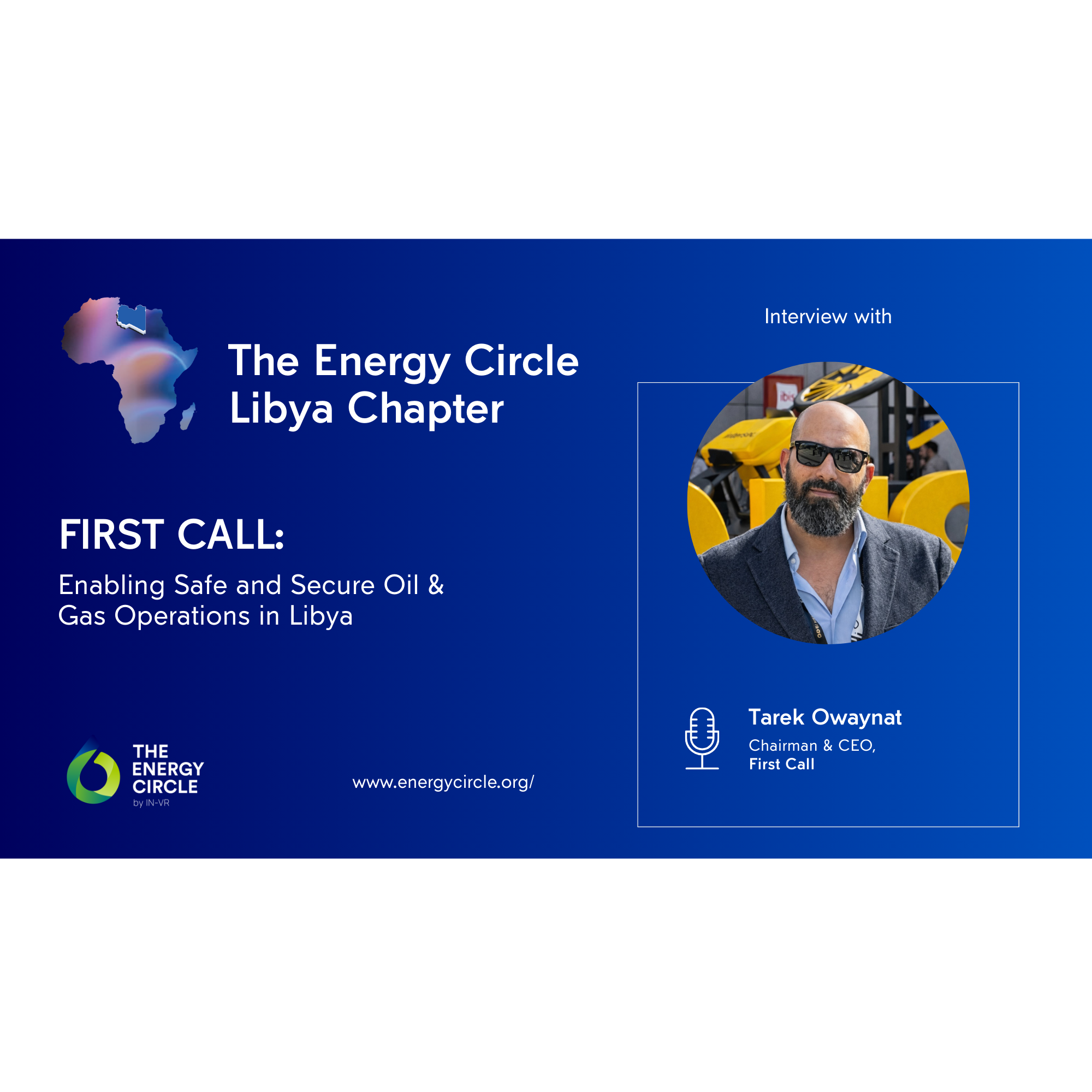
First Call discusses its rapid growth in Libya’s security sector, its role in protecting oil and gas assets, and how integrated command structures, training programs, and flexible deployment models support the country’s expanding energy operations.
Founded in 2020 with the objective of reshaping the security landscape in Libya, First Call has rapidly positioned itself as a key partner for the protection of oil and gas assets across the country. In this conversation, Chairman and CEO Tarek Owaynat explains how the company combines local expertise, structured operations, and proactive security planning to create safer conditions for energy investments in complex environments.
The discussion traces First Call’s evolution, including its role in supporting national security structures, and outlines the coordination models used to protect sites and personnel through integrated command systems and a centralized Security Operations Center. It also explores how the company is expanding its capabilities alongside the growth of Libya’s energy sector, focusing on flexible staffing models, advanced training programs, and strong engagement with local communities to ensure reliable and scalable security support.
Q1: How does First Call support the protection of oil and gas assets in Libya?
A1: Our journey began in 2020, when we managed a contract to train 160 members of the Ministry of the Interior’s Facility Security Department, this courageous program went on to be the seed of what stands today as the Facility Security Authority, the Libyan Authority that regulates private security in Libya.
But before that in 2020, First Call at its core, is an initiative, a bold statement to revive the economic landscape in Libya, our goal was always to enhance the security services and enable smooth operations across the country to pave the paths to a better economy. Libya’ economy is built on Oil & Gas revenues; our work focuses especially on offering potential investors the safety to navigate the complex reality.
We go one step further than everyone else, our support is tailored, agile and easily integrated to our clients, empowered by our auditing committee that works on the ground and ensures full legal compliance throughout our processes.
Q2:What coordination models are most effective for site and personnel security?
A2: Knowing the context in Libya, I can tell you that there is no right answer, each coordination model offers certain characteristics and specifications that fit into the client’s operations, in reality, adjustments will have to be made to accommodate the many variables that Libya’s nature enforces, this adjustment is not a fundamental change, but an acknowledgement of adaptability that is a vital layer of any security operations anywhere in the world.
There are layers to how we operate, our commercial team managed to establish a wide range of services that, in later stages, will be adapted by our experts according to the risk level, nature of operations, legal requirements, and much more.
Modern Security is about preventative measures rather than mitigation, a proactive system must acknowledge every aspect no matter how small, and what we understand is that “reacting to chaos, only creates instability through operations”.
A shorter answer would be telling you about our fully integrated Security Operations Center, a fundamental aspect of our work, the SOC took a life form of its own, managing operations, monitoring threat levels, and anticipating incidents before they happen, the SOC is also deployed during emergency, to coordinate with local authorities and facilitate effective responses. But since we operate across Libya, you’ll find that alternative models, like a site-based or regional-based Operation Rooms are vital, with project-specific command and control model with defined roles.
During emergencies, nothing is as precious as information, so our models support redundancy and clear role assignment, First Call always aims to be proactive, but when a reaction is necessary, it’s swift and final.
Q3: How is First Call scaling its services alongside energy sector growth?
A3: Our infrastructure - and we are proud to offer this ability to our client - enables us to upscale or downscale according to the client’s operations, this is through our flexible staffing models, clear internal SOPs and above all, great relationship with our staff.
Our Training Department and Human Resources Department are constantly monitoring trends, analyzing the market and forecasting potential growth, they enlist experts and headhunters to build rosters with a wide range of expertise allowing our operations to swiftly deploy new teams as necessary.
Our training department is especially important in this situation as our name and reputation are a guarantee of a high level of quality services, this is ensured by our comprehensive training models, and demand-driven capacity development.
We learn, document, automate and transfer the fruits of this knowledge to our teams guaranteeing excellent services and loyalty. Our scaling capacity is also an integral part of our values, we work with the communities around us, growing together and evolving side by side, this creates an efficient dynamic where First Call’s success reflects on the community positively.
So, how do we scale? It’s a strategy, it’s data collection and analytics, it’s carefully crafted vetting, recruitment and deployment procedures, long and endless hours of work to enables to say proudly, no matter how big or small, First Call will dominate it.

.png)